Before you read
How sure are you about 2034?
Picture education in 2034: how learners are taught, assessed and certified, and what AI is doing in the room. How confident are you that you know what it will look like?
Watch · Part One from Paul
Will schools still be relevant in 2034?
Paul’s talk for TEDx Chiang Mai: the class of 2034, why the old playbook isn’t working, and three scenarios. Captions are on; turn them off in the player.
The talk’s three scenarios are a short version of the book’s four futures for 2035 in Chapter 4. Paul works with Brave Generation Academy, which the talk mentions.
Listen
Hear the chapter
The Part One opening and Chapter 1 as they appear in the book, read in Paul’s voice.
Activity 1
Your class of 2034
The book starts with one real learner. Start with one of yours: your own child, a class you teach, or the students your university will admit. A first name or a class name is enough. It stays in this browser.
Timeline: 2026 now; 2034 the class of 2034 finishes school; 2035 the four futures in Chapter 4; 2045 the three futures in Chapter 5.
By 2034, AI may have changed what learning, work and qualifications mean. Or it may have developed more slowly than many forecasts suggest. Nobody can say which.
Activity 2
Futures, not forecasts
Forecasts about AI and education tend to swing between promise and alarm, and most of them will be wrong. That is why the book starts with futures rather than tools.
Scenario planning is a more useful discipline. Instead of predicting one future, you build several plausible ones, test today’s plans against each of them, and look for the choices that decide which future arrives. The aim is to stretch our thinking, so that plans hold up against futures that might come rather than the one we expect.
You will hear both kinds of thinking in staff rooms, board meetings and at the school gate. Sort these six statements.
Activity 3 · The central claim
Same AI, different futures
The future of education won’t be decided by AI capability alone. It will be decided by choices about access, ownership, governance, assessment and the role kept for teachers and learners.Chapter 1, the claim for the whole book
Test the claim yourself. Set how fast AI advances, then flip the five choices the chapter names. Watch which of the book’s four futures for 2035 you land in. Then try keeping the pace the same and changing only the choices.
Steady Hands
Gradual, well guarded, widely shared
Paced and Shared
Rapid, kept on a lead by checks and wide access
Hype and Gap
Gradual, thin oversight, benefits concentrated
Fast and Concentrated
Rapid, thin oversight, control in few hands
A simplification for this activity: three or more guarded choices put you in the top row. The four futures are the author’s construction [Speculative extension]. Chapter 4 explores them properly.
Activity 4
Where the choices are made
Many of those choices are being made now, in budget meetings, procurement contracts and assessment policies. Rarely in a meeting called “The future of AI”. For each room, say where you stand.
Activity 5 · The core skill
Telling evidence from imagination
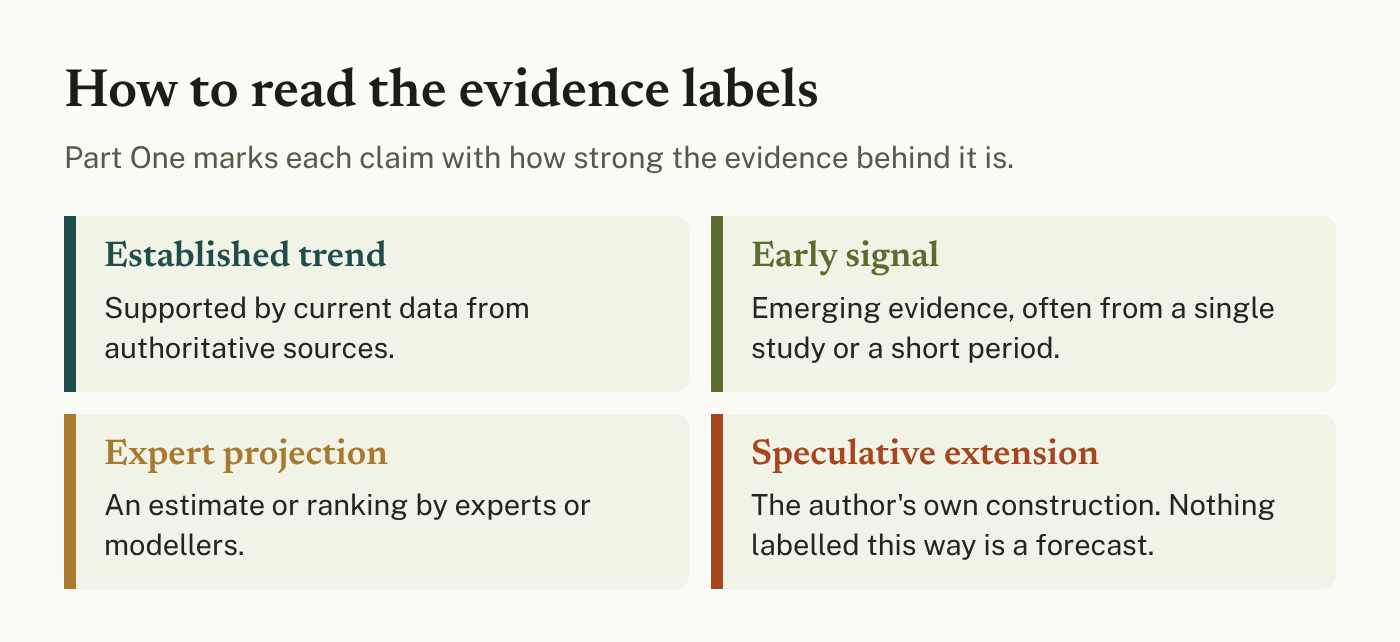
Writing about the future mixes evidence with imagination, and you should be able to tell which is which. Throughout Part One, every claim carries one of four labels. Here are eight claims from the coming chapters. Label each one, then see how the book labels it.
The road ahead
Three questions run through Part One
What pressures are already shaping the future of education?
What futures are plausible for 2035 and 2045?
Which decisions today most influence which future arrives, and what should institutions do now?
Where the material comes from: Part One draws on two series of articles Paul wrote for educators in 2026, one looking ahead to 2035 and one to 2045, and on his notes from UNESCO’s consultation on education beyond 2030. They are read alongside published scenario sets from the UK Government Office for Science, the World Economic Forum, the OECD, UNESCO, and EdTech Hub with the International Development Research Centre.
Check your understanding
Four questions
Reflect
Think it through
The first prompt comes from the book’s Think it through page for Part One. Your answers collect in My notes.
Take it to a meeting
One question to ask this week
Which label does that claim carry?
The next time someone makes a confident claim about AI in education, in a staff meeting, a sales pitch, a parents’ evening or the news, ask which of these it is:
- Established trend: current data from authoritative sources
- Early signal: one study, or a short period
- Expert projection: an estimate or ranking
- Speculation: someone’s construction, not a forecast
Then ask the book’s question: what kind of AI, used how, and checked by whom?
What this can’t tell you
The limits, stated plainly
Scenarios are not forecasts. The futures for 2035 and 2045 are the author’s constructions, and the expert rankings cited in Part One are opinion gathered in workshops. Some evidence for current pressures comes from early or single studies.
The published scenario sets were developed mainly in the Global North. EdTech Hub’s studies are an exception, but neither they nor the UK report name Thailand or Myanmar, which Paul’s own series sought to address. Part One also uses notes from a live UNESCO consultation, flagged as such.
Chapter complete
Finished Chapter 1?
Next in Part One: Seven pressures already in the room. Money, teachers, universities, learning, first jobs, research and population, and the evidence label on each.